Dermal fillers, when used with anatomical understanding, restore the facial scaffolding lost through bone remodelling and fat pad migration, rather than simply adding bulk.
- Facial ageing involves changes to bone, fat pads, muscle, and skin simultaneously, not just surface volume loss.
- Dermal fillers, when placed with anatomical precision, restore structural support rather than simply inflate tissue.
- Fat pad migration and bone remodelling are the primary drivers of the hollowing and sagging you may notice.
- A careful, anatomy-informed assessment is essential before any filler treatment to determine what has changed and where support is needed.
- Ultrasound technology enhances safety and precision by mapping vascular structures and guiding filler placement.
Dermal fillers restore facial structure by addressing the underlying causes of ageing: bone remodelling, fat pad migration, and soft tissue descent. Rather than simply adding volume, structural filler treatment repositions support, restores facial scaffolding, and creates natural enhancement that reflects how the face actually changes over time.
You look in the mirror and notice something has shifted. Not dramatically, not overnight, but gradually. The cheeks that once sat high have softened downwards. There is a hollowness beneath the eyes that was not there before. The jawline feels less defined. You might assume the answer is simple: add some volume back and things will look as they did. But that assumption is exactly where many filler treatments go wrong.
Dermal fillers restore facial structure by addressing the underlying causes of ageing: bone remodelling, fat pad migration, and soft tissue descent. Rather than simply adding volume, structural filler treatment repositions support, restores facial scaffolding, and creates natural enhancement that reflects how the face actually changes over time.
Understanding this distinction is not just academic. It directly affects whether your treatment looks natural or overdone, whether it addresses the real cause of what you are seeing, and whether the enhancement you experience is one that holds up well over time. The face ages in three dimensions and across multiple tissue layers simultaneously. Any treatment that ignores this complexity risks producing outcomes that look inflated rather than restored.
This article explains the science behind structural facial change, how hyaluronic acid-based dermal fillers can address those changes when placed with anatomical precision, and what a careful, anatomy-informed assessment involves before any treatment begins. Whether you are considering filler for the first time or questioning why a previous treatment did not quite deliver what you hoped, understanding the structural basis of facial ageing is the most useful starting point.
—
The Ageing Face Is a Structural Problem, Not Just a Volume Problem
What actually changes in your face as you age
Facial ageing is not simply a matter of skin becoming looser or tissue deflating. Research in facial anatomy has established that ageing involves simultaneous changes across four distinct layers: bone, fat, muscle, and skin. Each layer changes at its own rate and in its own way, and the interaction between these layers is what produces the visible signs you notice.
Bone provides the foundational scaffolding of the face. The fat pads sit above it, giving the face its contour and softness. Muscles lie beneath and between the fat compartments, and skin drapes over everything. When any one layer changes, the layers above it are affected. This is why addressing only the surface rarely produces satisfying outcomes.
Skin loses collagen and elasticity progressively from the mid-twenties onwards. But skin changes alone do not account for the structural shifts that become visible in the thirties, forties, and beyond. The more significant drivers are what is happening beneath the skin.
Why ‘adding volume’ is the wrong way to think about filler
The idea that facial ageing is primarily about volume loss, and that filler simply replaces what has been lost, is an oversimplification that has led to a generation of over-treated faces. You have likely seen the result: faces that look puffy or heavy rather than refreshed, cheeks that sit too low, or a general look of inflation that reads as unnatural.
The problem is not with dermal fillers themselves. It is with the mental model guiding their use. If a practitioner thinks of filler as a substance to be added wherever something looks hollow, they will fill the symptom rather than address the cause. Hollowing beneath the eyes, for example, is rarely solved by placing filler directly in the hollow. The cause is often structural: bone recession at the orbital rim and descent of the midface fat pads. Treating the cause, rather than the surface appearance, produces a more natural and longer-lasting improvement.
Structural filler treatment requires a different starting point: not “where does this face look hollow?” but “what has changed anatomically, and where does support need to be re-established?”
—
Bone Remodelling and Why It Matters for Filler Placement
How the midface skeleton changes over time
The bones of the face are not static. Research in anatomical cadaver studies and imaging has consistently shown that facial bones undergo remodelling throughout life, with measurable recession occurring at key sites including the orbital rim, the pyriform aperture around the nose, the maxilla, and the malar eminence (the bony prominence of the cheekbone).
This recession matters because the skeleton is the deepest layer of facial support. When the bony foundation recedes, the soft tissue above it loses its structural anchor. The fat pads that once rested on a well-supported scaffold begin to descend. Skin that was held in position by firm underlying structure starts to follow gravity more readily.
For someone in their forties or fifties, the hollowing they notice beneath the eyes or the flattening of the cheek may not be primarily about lost fat. It may be a direct consequence of the bony support beneath having gradually receded. Placing filler superficially in these areas without accounting for the skeletal change beneath will produce a limited improvement at best.
The role of the jawline and chin in facial balance
The jaw and chin undergo their own remodelling with age. The mandible (lower jaw) loses height and projection, the chin can appear to recede, and the angle of the jaw softens. This changes the overall proportions of the face: the lower third becomes less defined, and the relationship between the midface and the lower face shifts.
A practitioner who understands facial skeletal anatomy will assess the jawline and chin not in isolation but in the context of the full face. Restoring definition to the jawline or projection to the chin can have a significant impact on overall facial balance, often making the midface look more lifted simply by restoring the lower structural frame.
—
Fat Pad Migration and What It Does to Your Facial Contours
Understanding the facial fat compartments
The face contains multiple distinct fat compartments, each separated by fibrous structures called retaining ligaments. These compartments are not a single continuous layer of fat. They are discrete pockets, and they behave independently of one another as you age.
The key compartments relevant to facial ageing include the deep medial cheek fat, the suborbicularis oculi fat (SOOF), the superficial medial cheek fat, and the nasolabial fat. Each of these compartments changes in volume and position with age, and the changes are not uniform. Some compartments lose volume whilst others descend in position. Some areas appear hollow because the fat above has moved, not because fat has been lost.
This distinction is clinically important. If a hollow is caused by fat pad descent rather than fat loss, adding volume directly to the hollow may worsen the problem by increasing the weight of tissue that is already under gravitational stress.
How descending fat pads create hollows, folds, and jowling
As the retaining ligaments that anchor the fat pads to deeper structures weaken with age, the fat compartments begin to migrate downwards and medially. This movement creates a characteristic pattern of change that you may recognise in your own face or in photographs taken over the years.
The descent of the midface fat pads creates a relative hollowing in the upper cheek and beneath the eyes, whilst simultaneously creating fullness and heaviness in the lower cheek and nasolabial area. The nasolabial fold deepens not because new tissue has formed there, but because the fat above it has descended onto it. Jowling along the jawline occurs as lower face fat pads descend over the mandibular ligament.
Understanding this pattern explains why structural filler treatment focuses on restoring support in the midface and deep compartments, rather than filling the folds and hollows directly. Lifting the foundation lifts what rests upon it.
—
How Structural Filler Treatment Differs from Volume Addition
Restoring support from deep to superficial layers
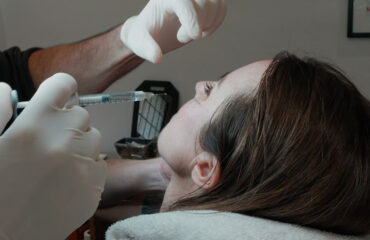
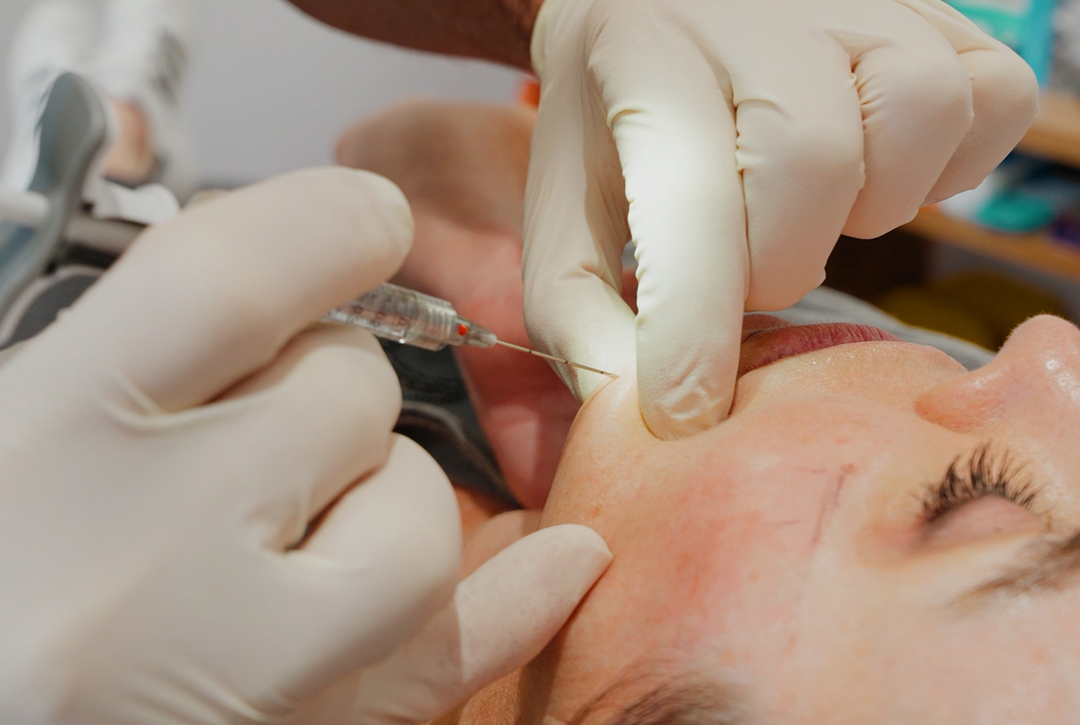
Structural filler treatment works from the inside out. Rather than beginning at the surface concern, a structurally informed approach starts at the deepest appropriate layer, typically the periosteal plane immediately above bone, and builds support upwards through the tissue layers.
Hyaluronic acid-based dermal fillers placed at the periosteal level act as a new foundation, effectively replacing some of the projection and support that bone recession has removed. This deep placement provides a platform for the overlying fat pads and soft tissue. Because the product is placed against bone, it is well-supported and generally lasts longer than filler placed in more superficial or mobile tissue.
Once deep structural support has been addressed, a practitioner can then assess what, if anything, is needed in the intermediate and superficial layers. Often, restoring deep structure reduces the apparent severity of surface concerns, meaning less product is needed overall and the outcome looks more natural.
The mid-face as the foundation of facial support
The midface, broadly the area from the lower eyelid to the upper lip and from the nose to the ear, is the structural centre of the face. It is where the most significant age-related changes tend to occur earliest, and it is the area whose support most directly influences the appearance of both the upper and lower face.
A well-supported midface holds the lower eyelid in position, maintains cheek projection, prevents premature descent of the nasolabial tissue, and provides the structural counterbalance that keeps the lower face looking defined. When midface support is lost, the effects cascade upwards and downwards simultaneously.
This is why many structural filler protocols begin with the midface, even when your primary concern may be elsewhere. Restoring the foundation first allows a clearer picture of what additional treatment, if any, is genuinely needed.
—
Assessment Before Treatment: Why Anatomy Guides Every Decision
What a structural filler assessment involves
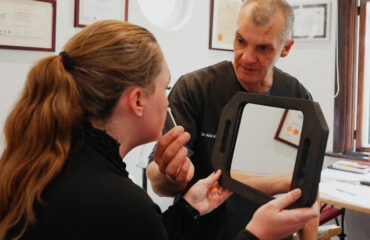
A structural filler assessment at Dr Alek Nikolic’s practice goes well beyond looking at surface concerns. It involves a detailed analysis of your facial proportions, skeletal support, fat pad position, skin quality, and soft tissue behaviour, considered together rather than in isolation.
Your practitioner will assess the degree of bone recession at key sites, the position and volume of the major fat compartments, the integrity of the retaining ligaments, and the overall balance of the upper, middle, and lower thirds of your face. This is not a quick visual scan. It is a considered anatomical evaluation that informs every decision about whether treatment is appropriate, what type of filler and technique is indicated, and which areas genuinely need support.
VISIA skin analysis may be used to assess skin quality and subsurface changes that are not visible to the naked eye, providing additional context for the personalised protocol. The assessment also includes an honest conversation about your concerns, your goals, and what is realistically achievable. If treatment is not appropriate, or if a different approach would serve you better, that will be communicated clearly.
How ultrasound technology supports safe and precise placement
Ultrasound technology plays an important role in both the safety and precision of structural filler treatment. The face contains a complex network of blood vessels, and the risk of inadvertent intravascular injection, whilst low in experienced hands, is the most serious potential complication of filler treatment. Ultrasound allows your practitioner to visualise vascular structures before injection, reducing the risk of placing product near a significant vessel.
Beyond vascular mapping, ultrasound supports real-time guidance during deeper structural placements, particularly in areas like the preperiosteal midface and the jawline where precise depth matters. It also assists in the assessment of tissue layers and, if needed, in the management of any complications that may arise.
At Dr Alek Nikolic’s practice, ultrasound is integrated into the assessment and treatment process as part of a safety-first approach, not as an optional add-on. This reflects a commitment to evidence-based practice and to the kind of precision that structural placement requires.
—
What Natural Filler Outcomes Actually Look Like
The difference between restoration and transformation
Natural enhancement from structural filler treatment does not look like a procedure. It looks like you, at your best. The goal is not transformation. It is restoration of the support and proportion that time has gradually altered.
When structural filler treatment is well executed, the changes are often noticed by others without being identified as treatment. Colleagues may say you look well-rested. Friends may comment that something looks different without being able to articulate what. This is the hallmark of anatomically informed treatment: the face looks balanced and refreshed rather than altered.
The contrast with volume-only approaches is meaningful. Faces treated with a structural philosophy tend to look lighter and more lifted, because the support is coming from the right depth. Faces treated with a volume-only approach can look heavier over time, as product accumulates in areas that were already under gravitational stress.
Realistic expectations and dermal filler longevity
Dermal filler longevity varies depending on the product used, the depth of placement, the area treated, and your individual metabolic rate. As a general principle, fillers placed in deeper structural layers, such as the periosteal midface or the jawline, tend to last longer than those placed in more superficial or mobile areas. Many people find that maintenance intervals extend over time as structural support is gradually re-established.
It is also worth understanding that structural filler treatment is not a single event. It is a process of gradual, conservative enhancement over time. Starting with less and assessing the response is always preferable to over-treating at a single session. Your personalised protocol will reflect this philosophy, with treatment decisions made incrementally rather than all at once.
—
Dermal Fillers in Cape Town: What to Look for in a Practitioner
If you are considering structural filler treatment in Cape Town, the quality and safety of your outcome will depend significantly on the practitioner you choose. Not all filler treatments are equal, and not all practitioners approach the face with the same level of anatomical understanding.
Look for a practitioner with formal medical training and a demonstrable understanding of facial anatomy across all tissue layers. Credentials matter: Dr Alek Nikolic serves as an Allergan Local Country Mentor in Facial Aesthetics and has lectured internationally, which reflects a level of engagement with evidence-based practice that goes beyond routine clinical work.
A diagnostic-first methodology is the most reliable indicator of a practitioner who will serve your interests well. This means that assessment precedes treatment, that your anatomy guides the protocol rather than a standard menu of procedures, and that a practitioner is willing to advise against treatment when it is not appropriate.
The integration of ultrasound technology into the assessment and treatment process is a further marker of a safety-conscious practice. In South Africa, the HPCSA registers qualified practitioners, and it is reasonable to verify registration before proceeding with any treatment.
Finally, be cautious of any consultation that feels sales-led rather than education-led. A practitioner who takes time to explain what has changed in your face, why it has changed, and what treatment can realistically achieve is one whose approach is aligned with your long-term interests. At Dr Alek Nikolic’s practice, the assessment always comes first, and treatment follows only when it is genuinely indicated.
—
Frequently Asked Questions About Structural Dermal Filler Treatment
What is the difference between structural filler treatment and simply adding volume?
Structural filler treatment uses an understanding of facial anatomy to restore support to specific layers of tissue, including deep fat compartments and areas of bone recession, rather than broadly adding bulk. The goal is to address why the face has changed, not just to fill in what looks hollow. This approach typically produces more natural enhancement and avoids the overfilled appearance that can result from volume-only thinking.
How does bone remodelling contribute to facial ageing?
Research in facial anatomy indicates that the bones of the face, including the orbital rim, cheekbones, and jaw, gradually recede with age. This reduces the skeletal support that holds overlying soft tissue in place. As the foundation shifts, fat pads and skin descend, creating hollowing, flattening, and the appearance of sagging.
Can dermal fillers address fat pad migration?
Yes, to a meaningful extent. Hyaluronic acid-based dermal fillers placed in the deep fat compartments of the midface can restore the scaffolding that supports displaced fat pads. This re-establishes the structural platform beneath them, which can lift and recontour the overlying tissue and soften folds like the nasolabial lines.
How long do dermal fillers last when used for facial structure?
Longevity varies depending on the product, the depth of placement, the area treated, and individual metabolic factors. Fillers placed in deeper structural layers typically last longer than those placed in more superficial or mobile areas. Many people find that maintenance intervals extend over time as structural support is gradually re-established.
Is ultrasound guidance necessary for dermal filler treatment?
Ultrasound is not required for every filler treatment, but it significantly enhances safety and precision for structural placements in areas with complex vascular anatomy. At Dr Alek Nikolic’s practice, ultrasound is integrated into the assessment and treatment process as part of a safety-first approach.
What does a structural filler assessment involve?
A structural filler assessment involves a detailed analysis of facial proportions, skeletal support, fat pad position, skin quality, and soft tissue behaviour. Your practitioner will assess what has changed anatomically and determine where structural support is most needed, informing a personalised protocol rather than a standard approach.
How do I know if I need structural support or surface treatment?
This is precisely what a careful consultation is designed to determine. A practitioner who understands facial anatomy will identify whether the issue originates in bone recession, fat pad descent, skin laxity, or a combination, and recommend treatment accordingly. Addressing the wrong layer can produce poor outcomes.
Are dermal fillers safe for facial structure restoration?
When performed by a medically trained practitioner using appropriate techniques and technology, dermal fillers have a well-established safety record. Risk is minimised through detailed pre-treatment assessment, knowledge of facial anatomy, use of ultrasound where indicated, and careful product selection. A frank discussion of potential risks forms part of every consultation.
What is the right age to start thinking about structural filler treatment?
There is no single correct age. Structural changes begin earlier than most people realise, and some benefit from early, conservative intervention to maintain support before significant descent occurs. An in-depth assessment is the most reliable way to determine whether treatment is appropriate for you at any given stage.
How do I find a qualified practitioner for dermal fillers in South Africa?
Look for a practitioner with formal medical training, demonstrated knowledge of facial anatomy, and a diagnostic-first approach. In South Africa, the HPCSA registers qualified practitioners. Credentials such as international mentoring roles, continued medical education, and the use of advanced technology like ultrasound are indicators of a practitioner who prioritises safety and evidence-based practice.
Related Articles
- Realistic Expectations for Dermal Filler Results: What to Expect and When
– Related cluster article - Anatomy-Informed Assessment for Dermal Fillers: Why Your Face Is Unique
– Related cluster article