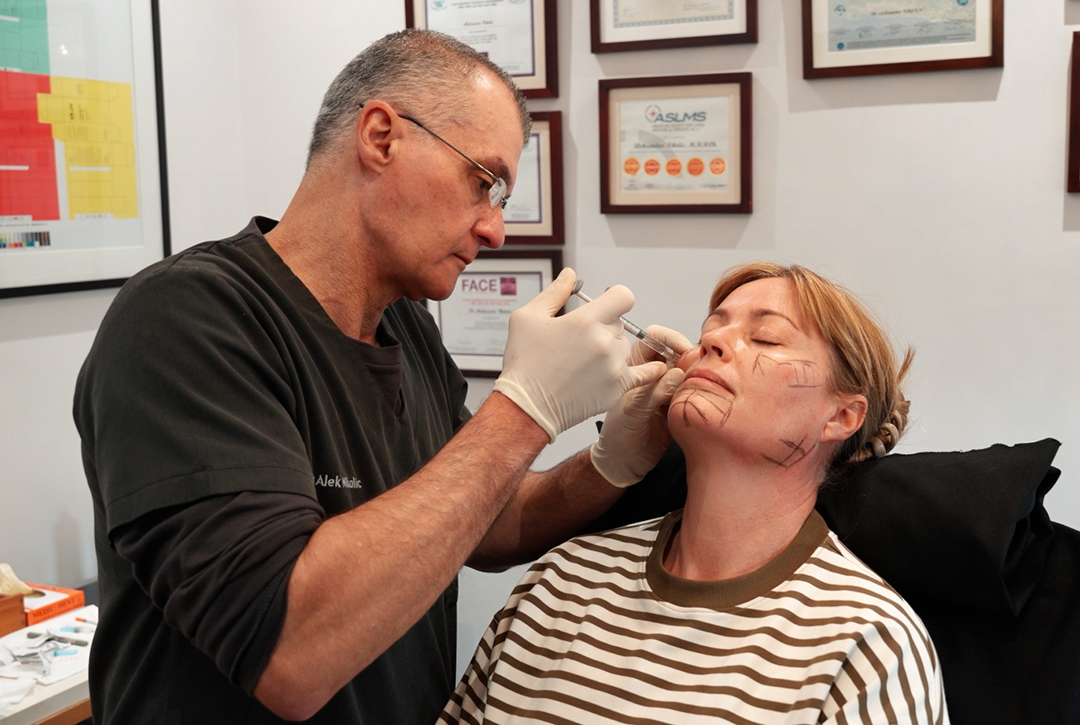
Dermal filler results are gradual, individual, and designed for subtle enhancement rather than dramatic change, with outcomes shaped by your anatomy, lifestyle, and the skill of your practitioner.
- Swelling and mild bruising after filler treatment are normal and do not reflect your final outcome; allow two to four weeks before assessing results.
- Longevity varies by treatment area and individual metabolism, typically ranging from nine to eighteen months for most hyaluronic acid-based dermal fillers.
- Natural enhancement of your existing features is the realistic goal; filler cannot replicate surgical outcomes or stop the ageing process entirely.
- Touch-up or review appointments are a normal part of filler treatment, not a sign that something went wrong.
- Realistic expectations begin with an honest, in-depth assessment that matches the treatment to your anatomy, not to a reference image.
Dermal filler results typically emerge over two to four weeks as initial swelling settles and hyaluronic acid integrates with surrounding tissue. Longevity varies by treatment area, product choice, and individual metabolism, generally ranging from nine to eighteen months. Natural enhancement, not dramatic transformation, is the realistic and appropriate goal.
You leave the clinic with your face treated, a little puffy, and probably holding a cold compress. The person looking back at you in the rear-view mirror does not look like the before-and-after photographs you spent weeks studying online. This moment, right here, is where most misconceptions about dermal fillers begin.
Knowing what actually happens to your face after treatment, and when, changes everything about how you experience and evaluate your outcome. The two-week window between injection and settled result is one of the least-discussed aspects of filler treatment, yet it has an outsized effect on whether you walk away satisfied or concerned. This article covers that timeline in detail, alongside the factors that determine how long your enhancement lasts, why individual outcomes vary so significantly, and how a careful assessment before treatment shapes what is realistically achievable for you specifically.
If you are still building your understanding of why structural placement matters as much as volume when it comes to natural-looking outcomes, the article on how dermal fillers restore facial structure rather than simply adding volume provides the anatomical context that underpins everything discussed here.
Quick answer: Dermal filler outcomes typically emerge over two to four weeks as initial swelling settles and hyaluronic acid integrates with surrounding tissue. Longevity varies by treatment area, product choice, and individual metabolism, generally ranging from nine to eighteen months. Natural enhancement, not dramatic transformation, is the realistic and appropriate goal.
—
The healing timeline: what your face goes through in the first four weeks
Days one to three: why swelling is not your result
The swelling you see in the first 48 to 72 hours after treatment is not filler. It is your body’s inflammatory response to the injection process itself, compounded by the water-attracting properties of hyaluronic acid as it begins to hydrate within the tissue. In areas with naturally looser, more mobile tissue, such as the lips or under-eye region, this swelling can be pronounced enough to look alarming if you were not expecting it.
Bruising, if it occurs, follows a similar arc. It typically peaks around day two or three before gradually fading over the following week. Neither swelling nor bruising is a reliable indicator of your final outcome, and attempting to assess your result during this phase will almost always lead to inaccurate conclusions.
Some asymmetry in these early days is entirely normal. The two sides of your face rarely swell at exactly the same rate, and what looks uneven on day two is very often balanced by day ten. Sleeping with your head slightly elevated, avoiding intense exercise for the first 24 to 48 hours, and keeping the treated area cool (without applying direct ice) all support a smoother early recovery.
Week two onwards: when filler begins to settle and integrate
Around days seven to ten, the initial swelling resolves and the hyaluronic acid begins to integrate more fully with the surrounding tissue. This is when you start to see something closer to your actual outcome. The product softens, becomes less palpable, and begins to move more naturally with your facial expressions.
By the end of week two, most of the structural enhancement placed during your treatment becomes visible. Cheek projection settles into a more natural contour. Jawline definition, if that was your treatment area, becomes cleaner without the initial firmness. Lip enhancement softens from its early fullness into a more proportionate shape.
It is worth noting that hyaluronic acid-based dermal fillers continue to attract and bind water for several weeks after treatment. This means your outcome at week two may look slightly different again at week four, generally in a positive direction, as the product fully hydrates and integrates.
The two-week review: why it matters more than most people realise
A two-week review appointment is not simply a courtesy. It is a clinically meaningful assessment of how your specific tissue has responded to treatment, whether the volume distribution is balanced, and whether any refinement would improve the outcome.
Your practitioner can assess integration, check for any areas where the product has not settled as intended, and document your response for future treatment planning. If you have concerns about symmetry or feel that a particular area needs adjustment, this is the appropriate time to raise them. Attempting to assess or address concerns before the two-week mark, when swelling is still present, risks unnecessary intervention on a result that has not yet fully emerged.
—
How long do dermal filler results actually last?
Why longevity differs by treatment area
The widely cited range of nine to eighteen months is accurate as a general guide, but it conceals significant variation across different parts of the face. Areas with high muscular activity, such as the lips and the perioral region, tend to metabolise filler more quickly because the constant movement accelerates breakdown of the hyaluronic acid matrix. Structural areas with less dynamic movement, such as the temples or the mid-face, generally maintain their enhancement for longer.
Product characteristics also play a role. Hyaluronic acid-based dermal fillers are formulated with varying degrees of cross-linking, which affects their density, lift capacity, and longevity. A firmer, more cross-linked product placed deep to support bone-level structure will behave differently over time compared to a softer product used for superficial hydration or fine line correction. Your practitioner selects product characteristics based on the treatment area and the structural outcome required, not personal preference.
Lifestyle factors that influence how quickly filler metabolises
Your individual metabolic rate has a genuine effect on longevity. People who exercise at high intensity frequently tend to metabolise hyaluronic acid more quickly, likely due to increased circulatory activity and cellular turnover. This does not mean you should stop exercising; it simply means your maintenance interval may be shorter than average.
Sun exposure accelerates collagen degradation in the surrounding tissue, which can indirectly affect how well filler is supported over time. Consistent daily sun protection is one of the most practical things you can do to support the longevity of any aesthetic treatment, including dermal fillers. Smoking, chronic stress, and disrupted sleep all affect tissue quality in ways that influence how long enhancement is maintained.
Maintenance versus top-up: understanding the difference
These two terms are often used interchangeably, but they describe different clinical approaches. A top-up involves adding volume to an area before the previous treatment has fully resolved, which carries a risk of accumulation over time. A maintenance treatment is planned after the previous product has substantially metabolised, restoring the enhancement to its optimal level.
The diagnostic-first approach at Dr Alek Nikolic’s practice means that maintenance decisions are guided by assessment rather than a fixed calendar. How your face has responded, how much product remains, and whether your structural needs have changed all inform the timing and extent of any follow-up treatment.
—
What natural enhancement actually looks like after filler treatment
The ‘noticed but not identified’ benchmark for good filler work
The goal of well-executed dermal filler treatment is not that people notice your treatment. It is that people notice you look well, rested, or refreshed, without being able to identify why. This distinction matters enormously when you are setting expectations before treatment.
If a colleague comments that you look like you have been on holiday, or a friend says you seem less tired than usual, that is the benchmark being met. It reflects subtle structural restoration that reads as vitality rather than intervention. It is a very different outcome from treatment that draws attention to itself, and it is the appropriate goal for almost every patient seeking enhancement rather than transformation.
Why your reference images may not be a reliable guide
Before-and-after photographs circulating online, and particularly on social media, are subject to several distortions that make them unreliable as personal benchmarks. Lighting, angle, expression, camera settings, and post-processing all affect how dramatic a change appears. Many of the most-shared images show transformations that involved multiple treatments across different modalities, not a single filler session.
There is also a selection bias at work: practitioners and clinics share their most visually striking outcomes, not their representative ones. The image that captures your attention is likely an outlier, not a typical result.
Bringing reference images to your consultation is genuinely useful for communicating your aesthetic preferences and the direction you would like to move towards. It becomes a problem when those images set a specific volumetric expectation that may not be anatomically appropriate for your face, or that represents a level of treatment beyond what would look natural on you. A practitioner committed to honest assessment will use your references as a communication tool, not a treatment target.
—
When results fall short: understanding why outcomes vary between individuals
The role of skin quality, tissue laxity, and bone structure
Dermal fillers work within the constraints of your existing anatomy. The quality of your skin, the integrity of your soft tissue, and the underlying bony structure all determine how much an injectable treatment can achieve and how visible that achievement will be.
Skin with significant laxity, where the tissue has lost substantial elasticity, may not reflect structural filler placement as clearly as skin with better tone. This is not a failure of the treatment; it is a reflection of what injectable treatments can and cannot do. In some cases, dermal fillers are most effective as part of a broader approach that also addresses skin quality, which is where treatments like microneedling with Dermapen 4 or skin booster bio-remodelling treatments may be recommended alongside structural filler work.
Bone structure similarly sets the parameters. Someone with naturally prominent cheekbones will show cheek filler placement differently to someone with a flatter mid-face. Neither is better or worse; they simply require different approaches and produce different visible outcomes from the same volume of product.
Why the same volume of filler produces different outcomes in different faces
Two people receiving the same volume of hyaluronic acid in the same treatment area can have noticeably different visible outcomes. Tissue density, the depth of the fat compartments, skin thickness, and the degree of pre-existing volume loss all affect how visible the enhancement is from the outside.
In a face with significant structural volume loss, the same amount of filler may be largely absorbed into restoring lost architecture, with relatively modest visible change. In a younger face with less volume depletion, the same volume may produce a more immediately visible effect. This is why volume alone is not a meaningful way to set expectations, and why your assessment needs to account for your specific starting point.
What to do if your results are not what you expected
If your outcome at the two-week mark does not meet your expectations, the first step is an honest conversation with your practitioner. A good practitioner will want to understand specifically what concerns you, assess whether the outcome is within the expected range for your anatomy, and discuss whether refinement is appropriate.
Hyaluronic acid-based dermal fillers have the significant advantage of being dissolvable. If a result is genuinely unsatisfactory or if product placement needs to be corrected, an enzyme can be used to dissolve the hyaluronic acid safely. This is not a routine step, but it is a meaningful safety net that makes hyaluronic acid the preferred choice for most aesthetic filler treatments.
—
Setting expectations before treatment: the role of a careful assessment
How VISIA skin analysis informs realistic goal-setting
VISIA skin analysis captures detailed information about your skin at a subsurface level that is not visible during a standard visual assessment. It documents texture, pigmentation, pore distribution, UV damage, and vascular patterns, providing a baseline that informs both your current skin health picture and your response to treatment over time.
For filler treatment specifically, VISIA analysis contributes to realistic goal-setting by revealing skin quality factors that affect what injectable treatments can achieve. If your skin shows significant subsurface UV damage or textural changes, that context shapes the conversation about what filler alone can address and what additional skin health work might be beneficial alongside it. It also creates a documented baseline so that your response to treatment can be objectively assessed at follow-up, rather than relying on memory or subjective impression.
Why an honest practitioner will sometimes recommend less than you ask for
One of the clearest signs of a practitioner whose values align with your long-term interests is their willingness to recommend less treatment than you have requested, or to redirect you towards a different approach entirely.
Over-treatment with dermal fillers is a real and visible phenomenon. Excessive volume in the wrong anatomical locations distorts rather than enhances, and the cumulative effect of repeated top-ups without proper assessment can shift a face away from its natural proportions over time. A practitioner who declines to treat, or who recommends a more conservative approach than you expected, is protecting your outcome rather than limiting it.
Dr Alek’s practice is built on the principle that assessment precedes every treatment decision. If your consultation reveals that your concerns are better addressed by skin quality treatment, or that the volume you are requesting would not sit naturally within your facial proportions, that conversation will happen before any treatment is planned.
Questions worth asking at your filler consultation
Arriving at your consultation with specific questions helps you get genuinely useful information and gives you a clearer sense of whether the practitioner’s approach aligns with your values. Consider asking:
About the assessment process: How will you assess my facial structure before deciding on placement? What does your assessment involve beyond a visual check? Will you use any diagnostic technology to inform your approach?
About realistic outcomes: What can I realistically expect from this treatment given my specific anatomy? What will my face look like at two weeks compared to six months? Are there aspects of my concern that filler cannot fully address?
About the product and technique: What type of hyaluronic acid product do you plan to use and why? How deep will the product be placed? What is your approach if I am not satisfied with the outcome at two weeks?
About maintenance: How will you assess when I need a follow-up treatment? What factors will influence how long my enhancement lasts?
The answers to these questions reveal whether your practitioner is working from a genuine assessment of your anatomy or from a more formulaic approach. A practitioner who gives specific, anatomy-referenced answers is working in a fundamentally different way to one who offers reassuring generalities.
—
Frequently asked questions
How long does it take to see the final result after dermal filler treatment?
Most people see something close to their final outcome at around two weeks, once initial swelling has fully resolved. Hyaluronic acid continues to hydrate and integrate for up to four weeks, so the result at week four is generally the most accurate representation of your settled enhancement.
Is it normal for filler to look uneven or lumpy at first?
Yes. In the first few days, swelling rarely distributes symmetrically, and the product itself may feel firm or irregular before it softens and integrates. Minor asymmetry and palpable firmness in the first week are expected, not cause for concern. If irregularity persists beyond two weeks, raise it at your review appointment.
Why do my filler results not look as dramatic as the before-and-after photos I have seen online?
Online before-and-after images are subject to significant distortion from lighting, angle, and post-processing. Many also represent multiple treatments across different modalities rather than a single session. Natural enhancement that reads as vitality rather than intervention is the appropriate goal, and by definition it will not look dramatic.
Do dermal fillers look worse as they wear off?
Hyaluronic acid metabolises gradually and evenly in most cases. You are unlikely to notice a sudden change; rather, the enhancement gradually returns towards your baseline over many months. Some people find that returning to their pre-treatment appearance feels more noticeable after experiencing the enhancement, which can create the impression that things look worse. Planning maintenance before full metabolisation avoids this perception.
Can I speed up how long my filler lasts?
You cannot extend longevity beyond what your anatomy and metabolism allow, but you can support it. Consistent sun protection, good sleep, stress management, and avoiding high-impact activities in the days immediately after treatment all contribute to maintaining your outcome for as long as possible.
—
Realistic expectations are not a limitation on what dermal filler treatment can achieve. They are the foundation on which genuinely satisfying outcomes are built. When you understand the healing timeline, the factors that shape longevity, and the anatomy-specific variables that affect your individual response, you are in a position to evaluate your outcome accurately and make informed decisions about ongoing care.
If you are considering dermal filler treatment and would like a careful, assessment-led consultation that addresses your specific concerns and anatomy, we welcome the conversation. Contact Dr Alek Nikolic’s practice to arrange your consultation.
Related Articles
- how dermal fillers restore facial structure
– Parent pillar explains the structural rationale for filler placement, which underpins why outcomes are subtle and anatomy-dependent rather than volume-driven.